
In the ever-growing journey of families who hold wealth, conflict is often seen as something to avoid. Yet, conflict is often not a sign of weakness or failure; it is in fact a sign of growth. Varying perspectives on business, investments, purpose of wealth, values, impact, and growth are natural across generations. However, these tensions can become moments of transformation when approached with honesty and courage. They create opportunities for deeper understanding, stronger bonds, and more intentional decision making.
Difficult conversations are an essential part of preservation. Just as financial capital must be carefully managed, a family's social and emotional capital must be safeguarded via open communication. By discussing differences, families create space for reflection, renewal, and alignment on what is important.
This article features content from the 2025 report: Insights from the Journeys of Eight Asian Families: Ten Key Actions for Investing for Impact, written in partnership with The ImPact. This report presents the Asian impact narratives of eight multi-generational families highlighting how these families align values, navigate family dynamics, and develop intentional investment approaches across their businesses, family offices, and philanthropy to integrate financial goals with social and environmental outcomes.
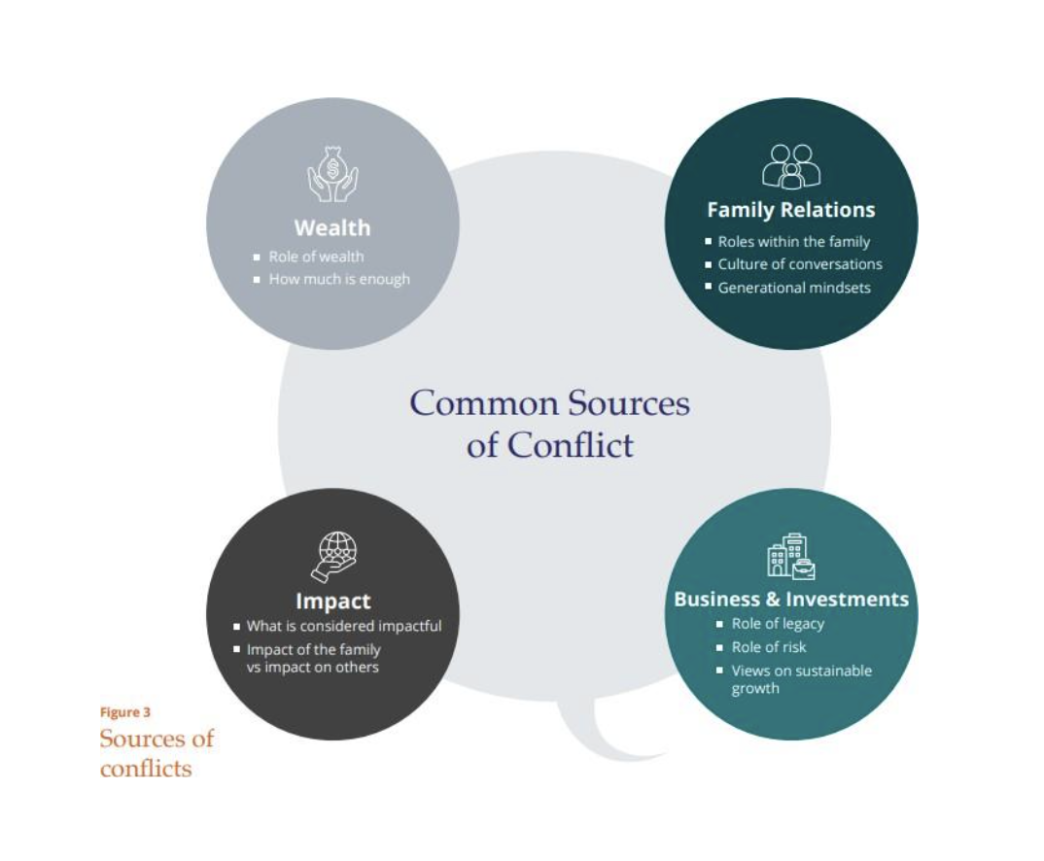
Across families negotiating these dynamics, four common causes of conflict emerge: attitudes towards wealth, dynamics of family relations, defining impact, and approaches to business and investment.
Attitudes Towards Wealth
The most fundamental source of conflict lies in how family members view wealth itself. Wealth is never neutral; it carries meaning that shifts across generations. For those who spent decades building it, wealth may symbolize sacrifice, hard work, and preservation. For younger generations, raised with access and security, wealth may be viewed as a tool for exploration, innovation, or even responsibility toward society.
For some, wealth can even feel like a burden. The responsibility of stewarding resources across generations can create pressure, guilt, or a sense of being defined by financial identity rather than personal choice. Yet when families allow space for reflection, slowing down, listening, and asking not only what wealth can do, but what it should mean - they begin to act with intention. This process transforms wealth from an obligation into an opportunity for purpose.
Defining Impact
Impact may mean different things to family members. Founders may see it as an outcome of business: spurring job creation and economic growth, while giving back to society via corporate social responsibility and philanthropic initiatives. Meanwhile, younger generations raised with privilege and global exposure may seek to leverage the family’s wealth for impact. Identifying common perspectives can help bridge generational gaps.
Navigating Family Relationships
Another source of friction is ingrained familial roles. Birth order, cultural expectations, and generational hierarchies can all produce powerful dynamics that influence how decisions are made. Parents may feel protected from their children's participation. Elders may worry whether younger members have the necessary skills or dedication to take the lead. Siblings may struggle with comparisons, obligations, and ambiguities between family, business, and personal identity.
Many cultures place a high value on familial obligations. The pull of filial piety or respect for hierarchy can sometimes impede open communication. Younger members may be hesitant to challenge seniors, and the elderly may struggle to surrender control.
Managing Business/ Investments
Conflicts over how to manage the business and investments are common. Younger members may advocate for stronger corporate governance through professional management and see sustainability as a key driver of long-term value. In contrast, senior members often favor traditional methods, viewing sustainability efforts with skepticism—as greenwashing or virtue-signaling—rather than essential evolution.
Reflections for navigating conflict and strengthening family alignment
- How does each family member personally view wealth - its meaning, purpose, and responsibility? Where do these perspectives converge or diverge?
- What does “impact” mean to your family today? How aligned are generational views, and where might deeper dialogue help bridge gaps?
- Which familial dynamics, roles, expectations, hierarchy, shape how decisions are made? How might these dynamics support or hinder open communication?
- How prepared is the family to hold difficult conversations with honesty, respect, and curiosity rather than defensiveness?
Next steps:
Learn more about your deployment of impact capital and family dynamics from CSP Wealth holder program and learn the different approaches to sustainable investing in CSP SG’s Advanced Sustainable Investing in Wealth Management courses, available at both a L3 (introductory) and L4 (intermediate) level.
References:
Koh, J., & Yum, P. (2025). Insights from the journeys of eight Asian families: Ten key actions to investing for impact. Centre for Sustainable Finance and Private Wealth & The ImPact.
https://www.cspglobal.org/research/publications/insights-journeys-eight-asian-families
You might also be interested in
This article features an extraction of content from the 2025 report: Insights from the Journeys of Eight Asian Families: Ten Key Actions for Investing for...

This article features adapted content from the publication: "Insights from the Journeys of Eight Asian Families: Ten Key Actions for Investing for...

Values are often the key to inspiring moral ambition in a family’s journey towards impact.
