


We are navigating a time of growing uncertainty with climate change, inequality, and global instability. For wealth-owning families, this presents a responsibility deploy impact capital to meet the growing need for funding solutions to today’s social, environmental, and economic crises. The journey is not easy, but it is urgent. And deeply human.
At the Centre for Sustainable Finance and Private Wealth, we turn research into practical training and tools for private wealth holders and the impact ecosystem. The latest instalment of our publications - Insights from the Journeys of Eight Asian Families: Ten Key Actions for Investing for Impact, written in partnership with The ImPact is the second edition following the original “Ten Ingredients to Impact Investing,” which featured families from the Americas and Europe. This second edition shifts its focus to Asia showcasing the Asian impact narratives of eight multi-generational families are purposefully aligning their capital, business, and values to build a better future.
Values anchor and guide a family’s approach to investing for impact and build enduring legacy.
We often wonder - what inspires moral ambition? Or motivate the family’s desire to purpose their wealth for good? The key - lies in the family values. Values anchor and guide a family’s approach to investing for impact. They shape how families live, relate, and make decisions across life, business, and investments. They have the superpower to transform how families view money - By shifting focus from self-interest - to gratitude, service, and a desire to create lasting impact; And moving the focus from “I” to “We,” and from ownership to stewardship. This is how a family build a legacy that creates meaningful impact; and push themselves to think beyond the sole pursuit of financial returns.
The invisible capital that guides the creation, preservation, and beneficial use of wealth is values. Wealth becomes a force to uplift, unite, and contribute meaningfully to the world. Legacy is redefined not just in preserving financial assets but also human capital, social capital, intellectual capital, and spiritual capital within the family, next generation and communities - by activating for good.
Values as a Way of Life, lived out within the family system
The below framework was developed based on the interviews in this study.
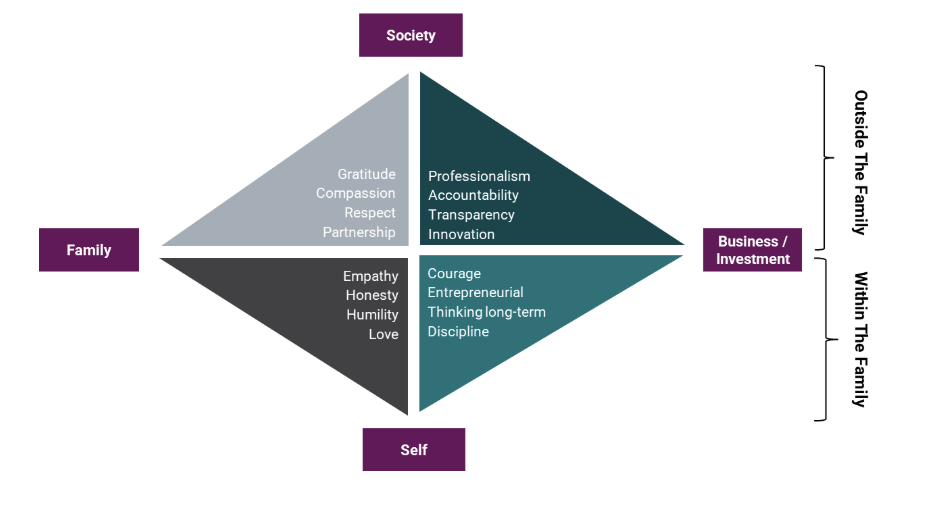
Values guide family relationships and how they engage with the wider community
On the left quadrant, we see values that guide family relationships and how they engage with the wider community.
Values like empathy, humility, honesty, and love, guiding how the family members relate to one another, and shapes relationships and decision making. These values flow outward and manifest as gratitude, compassion, respect, and partnership – to shape how family members view their roles and the family’s contribution in the broader society.
One example in this study is a multigenerational business family known for its strong values-driven approach. A next-generation family member shared how the family’s emphasis on humility, trust, respect, commitment, and courage was shaped by the experience of being welcomed by a community far from their place of origin. These values are lived out through role modelling across generations. As a fourth-generation member explained, observing how parents and earlier generations conducted themselves has strongly shaped her own behaviour. In raising her children, she continues this tradition through intentional conversations, exposure trips beyond their affluent home environment, and stories drawn from the people and work she engages with.
The same core values: humility, trust, respect, commitment, and courage, also guide the family’s operating business, shaping its culture and everyday practices. When the family established their philanthropic foundation, they adopted several of these values as the foundation’s guiding ethos, particularly respect, commitment, and courage. These principles now underpin how the team works together and how the organisation partners with others to create meaningful impact
Values play out in the family’s conduct in business & investment strategies, and in their engagement with external stakeholders.
Investment companies and family businesses are excellent venues for upholding moral principles. These values impact everything from supplier relationships to sustainability plans to employee well-being when they are ingrained in corporate culture, governance practices, and business models. Values centred family owners place a high value on opportunities for entrepreneurship, courage, long term orientation, innovation, growth, and psychological safety, and dignity of employees and external partners. These cultural decisions show a dedication to humble, disciplined, and caring impact leadership, stewardship, and character.
In one family case study, a central guiding philosophy is the idea of “Si Li Ji Ren” considering the greater good and the interests of others. This, “we are greater than I” mindset shapes the family’s investment approach within their venture firm, leading them to prioritise collective benefit over individual gain.
To remain agile in capturing new opportunities, the family embraces what they call a “6677” mindset, believing that having two-thirds confidence in a good enough opportunity to move forward. In practice, this translates into a willingness to experiment, iterate, learn, and adapt. Core values such as entrepreneurship, continuous innovation, taking calculated risks, respect, and discipline also guide how the family operates and governs both their business and philanthropic activities.
Reflections:
Wealthy families are discovering that their true wealth and greatest strength lie not only in financial capital, but in the values that they live by and guide their choices. These values help them stay grounded in times of uncertainty, guide long-term decisions, shape business practices, and influence how they navigate family dynamics, show up for one another in the family and for the world. They quietly steer how families give, lead, and build across generations.
Reflect on your own personal values and family values. What are important to you? What cannot be comprised? Where do you values come from – e.g. education, culture, religion, etc.? What are these values all about? How do they affect the way you relate in your family? What about how does it play out in the family business? What does it shape the purpose of your wealth and what you choose to do with your wealth? In your investments and what you desire for impact?
Next steps:
Learn more about your deployment of impact capital and family dynamics form CSP Wealth holder program and learn the different approaches to sustainable investing in CSP SG’s Advanced Sustainable Investing in Wealth Management courses, available at both a L3 (introductory) and L4 (intermediate) level.
References:
Koh, J., & Yum, P. (2025). Insights from the journeys of eight Asian families: Ten key actions to investing for impact. Centre for Sustainable Finance and Private Wealth & The ImPact.
https://www.cspglobal.org/research/publications/insights-journeys-eight-asian-families
You might also be interested in
Insights
Starting Your Family's Sustainable Investing Journey Part 4: How Do You Bring Others On The Journey?
The 3Cs framework: communication, connection, and commitment aims to help families find common ground and move forward together.

Insights
Starting Your Family's Sustainable Investing Journey Part 3: What Obstacles Will You Encounter?
Internal mindsets, family dynamics, and social norms are the real obstacles to sustainable investing. A guide on how to spot them.

Insights
Starting Your Family's Sustainable Investing Journey Part 2: Where Do You Want To Go?
Learn how to set clear ambitions and use the UN SDGs to define where you want your sustainable investing journey to go.
