
This report presents the Asian impact narratives of eight multi-generational families highlighting how these families align values, navigate family dynamics, and develop intentional investment approaches across their businesses, family offices, and philanthropy to integrate financial goals with social and environmental outcomes.
Figuring out an investment strategy is an iterative process. Through the interviews, we saw that families typically begin with a goal in mind and an idea of how they want to achieve that goal. They pick up lessons along the way to refine their goal and strategy over time, thus the Goal, Strategy, Accountability (GSA) approach. The key is to take a small step, get started, and iterate over time.
Setting a goal
When families explore investing impact, they often begin by clarifying what matters to them -financial returns, positive impact, or both. Their goals are shaped by their mindsets and broader priorities like sustaining the business, preserving legacy, supporting existing philanthropy efforts, or addressing critical social and environmental problems. Families may focus on areas where they have expertise, such as sectors linked to their business, or social and environmental issues they have addressed in past philanthropic work. Family members’ personal passions for certain themes also shape priorities.
Some families prioritize a certain level of financial return in their impact of investments— supporting wealth preservation, growth, or multigenerational need and layer in impact considerations. For example, some family offices and foundations require sufficient returns from their investments to fund ongoing philanthropic efforts and programs.
One family’s investment arm, while deploying a full spectrum of capital across varying return expectations, maintains a focused commitment to a single impact theme: health and well-being. This intentional focus allows the team to build deeper domain expertise, strengthen engagement, create synergies across their portfolio, and drive more systemic outcomes. By concentrating their efforts in this area, the firm ensures that impact remains central to decision-making and that financial returns are pursued with a clear sense of what is “enough.”
As part of the goal-setting process, families often rely on a broad set of non-family professionals to help align diverse perspectives and guide conversations toward what impact and financial returns the family wants.
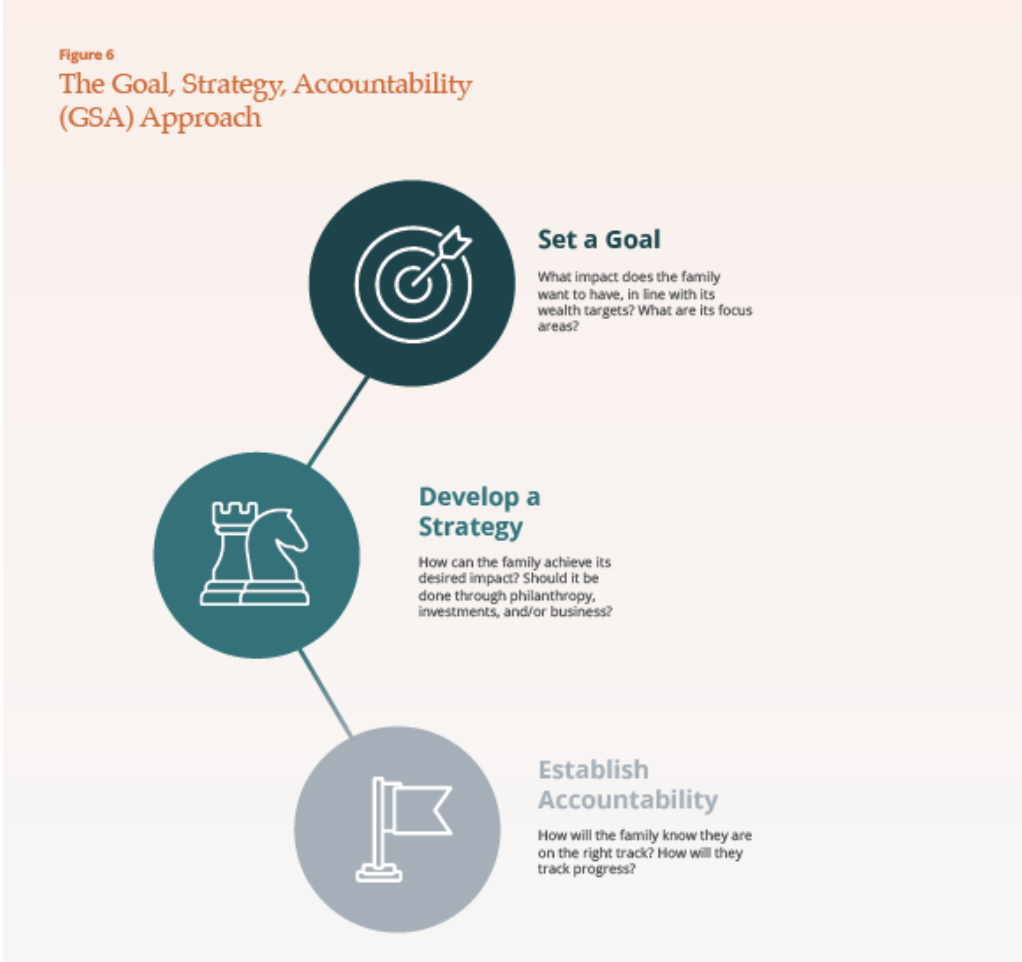
Develop a strategy
Depending on a family’s goal(s), our discussions with the families showed that any of the four key approaches of deploying capital across spectrum, going beyond traditional philanthropy and investment, investing in one’s business or outside the business can be used individually or in combination to achieve the desired impact. Families often draw on external advisors or in-house expertise to refine the family’s impact thesis, translating intent into a clear roadmap for deployment, risk management, and measurable outcomes.
A family’s approach is also rooted in the family’s broader mindset, for example, one that views spending down wealth or applying a systems lens as essential to creating meaningful impact and addressing complex global challenges. Some families also believe in being intentional about including marginalized voices as they create their strategies. These higher-level perspectives often shape how families define success and structure their long-term strategies for change.
Build accountability
To institutionalize their vision, families often formalize their impact thesis through
documents like a theory of change, investment policy, or mandate. These tools help define goals, track progress, and ensure alignment. Regular reviews create structured moments to assess and refine their strategy.
A family’s approach to impact measurement is tightly integrated with their approach to create change. It helps both qualify and quantify the outcomes they aim to achieve through their investments, becoming an integral part of the family’s screening, due diligence, decision-making, and exit processes. Without a clear impact goal and strategy, measuring outcomes for the sake of measurement alone may not yield meaningful results
Reflections for shaping your family’s journey:
- What are your family’s goals for wealth and impact?
- What are the entry points for impact? What family vehicles and entities can you use? How may you deploy across the spectrum of capital using different asset classes?
- What is your impact theory of change and measurable outputs and outcomes for accountability? How are you going to measure these?
Next steps:
Learn more about your deployment of impact capital and family dynamics form CSP Wealth holder program and learn the different approaches to sustainable investing in CSP SG’s Advanced Sustainable Investing in Wealth Management courses, available at both a L3 (introductory) and L4 (intermediate) level.
References:
Koh, J., & Yum, P. (2025). Insights from the journeys of eight Asian families: Ten key actions to investing for impact. Centre for Sustainable Finance and Private Wealth & The ImPact.
https://www.cspglobal.org/research/publications/insights-journeys-eight-asian-families
You might also be interested in
The 3Cs framework: communication, connection, and commitment aims to help families find common ground and move forward together.

Internal mindsets, family dynamics, and social norms are the real obstacles to sustainable investing. A guide on how to spot them.

Learn how to set clear ambitions and use the UN SDGs to define where you want your sustainable investing journey to go.
