
Coming into wealth can be overwhelming, but it can also provide you with an opportunity to make a positive impact. Enter the Investment Policy Statement (IPS)—a powerful tool to clarify your goals and guide your sustainable investing journey. This quick guide provides an essential starting point for an investor’s IPS.
These insights stem from our decade of experience at the Center for Sustainable Finance and Private Wealth working closely with private wealth holders and their families. Through our educational initiatives and direct engagement, we have helped numerous next-generation wealth holders develop both the technical expertise and interpersonal skills needed to align their investments with their values. This work has consistently demonstrated how private capital can be effectively deployed to create meaningful positive change while meeting financial objectives.
At its core, an IPS helps answer the crucial question: "What is the purpose of my wealth?" For impact investors, this goes beyond financial returns to encompass environmental and social objectives. A well-crafted IPS can:
- Establish asset allocation and risk management strategies
- Clarify responsibilities and governance
- Provide a roadmap during market turbulence
- Define what success looks like for your investments
A powerful driver for when the going gets tough, an IPS provides wealth holders with the opportunity to define what success looks like and provides clarity on what investments and practices are acceptable (or unacceptable) to them, so that their investment teams may freely optimize within these boundaries.
The Elements of an IPS
While traditional IPSs cover scope, governance, financial objectives, and risk management, an impact-oriented IPS—or impact IPS—provides crucial know-how on sustainability and impact goals.
By working on their scope and purpose, this provides the wealth holder with the opportunity to question “why” they want to begin this journey. Drawing from one’s interests and goals, the process allows the wealth holder to benefit from vital questioning: What is the purpose of my wealth? What impact or benefits do I want it to have on me, my family, my community, or the causes that are important to me? A constitution of sorts for a pot of capital, the statement of purpose can be as broad or as specific as the wealth holder desires and can be crafted according to their needs.
Furthermore, this section also includes statements on one’s vision and mission, as well as a “philosophy of impact”: a set of beliefs and principles that guide an investor’s decision-making process. This is where the investor defines their “shade of green”:
- Light green: the investor’s goal is to maximize wealth while doing no harm and benefiting from the transition to a more sustainable world.
- Medium green: the investor wants to achieve market returns, promote sustainable and impactful activities where possible, and benefit from the transition to a more sustainable world.
- Dark green: the investor proactively uses wealth for the greater good, delivering social and/or environmental impact, contributing to achieving the SDGs, and demonstrating additionality within impact.
First off, investors will consider exclusion criteria. The three different types of exclusions, as illustrated in the graphic below, are: norms-based (where companies that violate international treaties), business conduct (excluding severe cases of controversial businesses, e.g., UN Global Compact), or values-based.
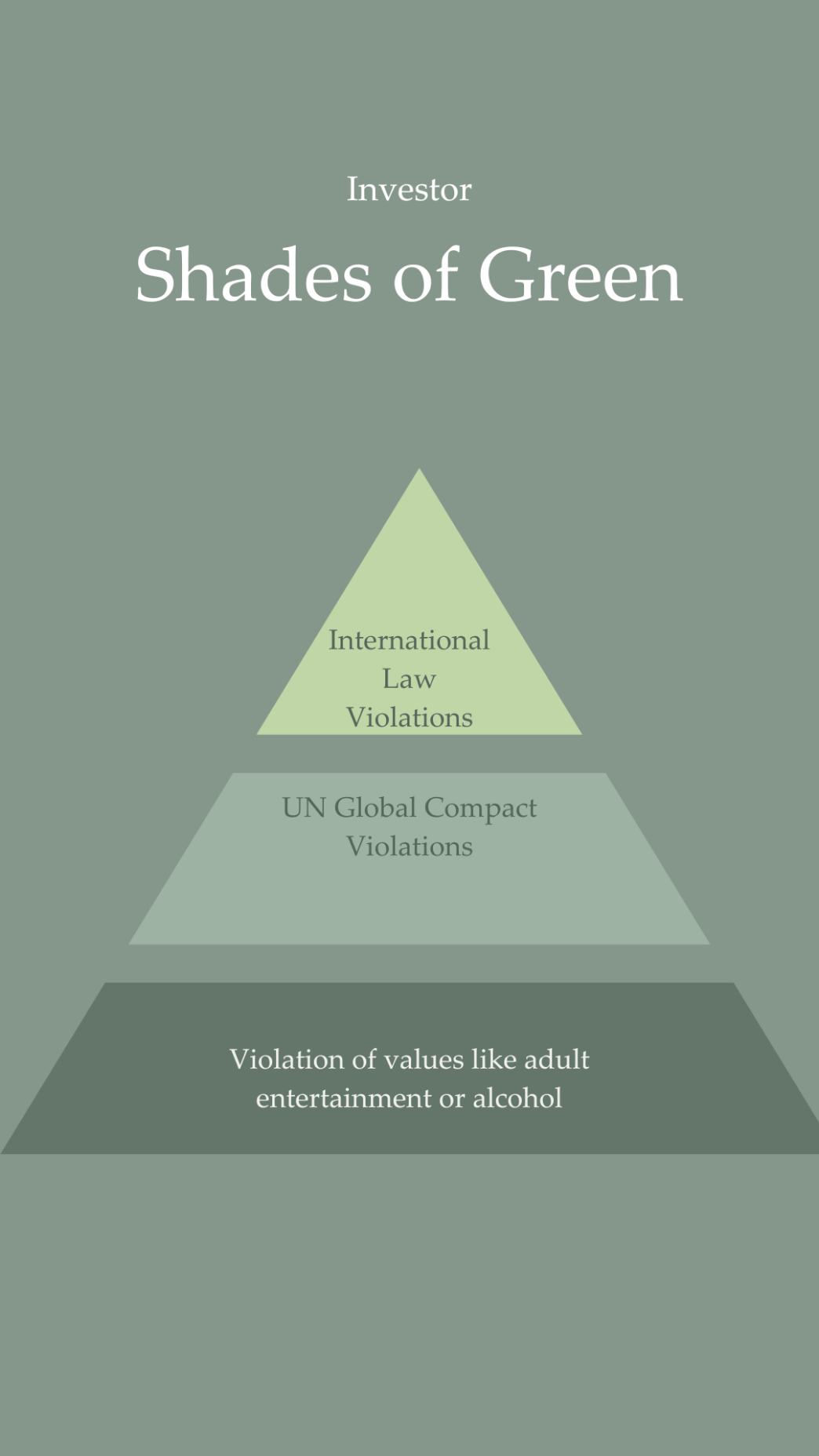
Further, while the light-green investor may not include any impact investing that is mobilizing private investment to achieve the Sustainable Development Goals, the dark-green impact investor will establish and seek to maximize their impact with measurable KPIs.
This will require impact at the investee level, but also at the investor level through:
- Capital additionality: financing projects that–likely–would have struggled to obtain that capital otherwise
- Impact-focused active ownership: investors (or funds) use their access to guide the direction of the companies they're invested in toward impact
- Intentionality: identifying whether investments truly aim to generate a positive impact
- Measurability: evaluating financing through a qualitative and/or quantitative analysis, with respect to the objectives stated in the context of intentionality
With a preference for high-impact strategies, these impact-focused investors will tend to include in their IPS mentions on investing in venture capital and frontier markets earlier-stage companies and funds, as well as public markets with activism and engagement.
Similarly, the dark green investor will engage with direct holding in portfolio companies on ESG issues and expect wealth managers to vote for most ESG-related shareholder proposals. At a more conservative level, the light and medium green investors will ask their managers to engage on financially relevant ESG issues or support ESG shareholder engagement collaborations, respectively.
Finally, the sustainability portion of the impact IPS should conclude with a measurement and reporting overview, including a breadth of measures according to the investor’s impact requirements: from just looking into the manager’s transparency (light), to stipulating industry best practices, requesting evidence of additionality and monitoring of any deviations from the policy with explanations and remedial action (dark).
Bringing your vision to life
Through our trainings at the Center for Sustainable Finance and Private Wealth (CSP), we've helped over 200 wealth holders develop impactful IPSs. Particularly, alumni of our Impact Investing for the Next Generation (IING) program report that this process was crucial for:
- Self-reflection on their goals and values
- Improving relationships with financial advisors
- Evolving their thinking on wealth's purpose
- Tracking progress on their impact journey
Crafting an impact IPS is not simple paperwork—it is about aligning your wealth with your vision for a better world. By clearly defining your impact objectives, you empower your investment team to optimize within boundaries that matter to you.
An IPS can be your roadmap to financial success and positive change.

You might also be interested in
Lean on your fellow wealth holders.

Systemic investing is an emerging approach to capital deployment.

Systems are complex, but getting started in systemic investing need not be.
