


Setting your sustainable investing ambitions and aims
“If you don't know where you're going, any road will get you there” , as the Cheshire Cat wisely tells Alice in Alice in Wonderland. This advice applies equally to investing. Without clear intentions, your investments will still produce an impact, just not necessarily the one you desire.
The global challenges facing our planet are too numerous and complex for any single individual, organisation or government to address alone. Yet your investments either contribute to these problems or help solve them. Building on your motivations from Article 1, effective sustainable investing is about knowing where you want to go.
In this second article, we explore:
- What are your sustainable investing ambitions and aims? And how would you set them down?
- How can the UN Sustainable Development Goals (SDGs) support your sustainable investing?
- What approach(es) can you take to focus on specific themes or issues?
Charting your sustainable investing journey
Your family’s sustainable investing journey offers many possible destinations as well as routes there. Navigating them well requires clear ambitions and aims for your portfolio.
Ambition: Articulating your vision
Every investment portfolio exists within the broader context of our personal aspirations for our lives. Setting an ambition for your wealth means expressing your vision for the future and what impact you want your portfolio to have on the world.
We generally see this starting with personal introspection: Why is your wealth important to you and your family? What world do you wish to see, and what influence should your capital have in creating it?
Consider a practical case. You and your family care about nature and the environment. You’re concerned though about the impacts of climate change. You recognise governments are struggling to meet Paris Climate Accord commitments to limit global warming to 1.5°C. Simultaneously, you can see your portfolio’s potential influence and want to actively invest into climate mitigation and adaptation solutions. Your ambition might therefore be to contribute to a healthy, regenerative environment.
Aims: Setting a course
While ambition provides your vision of the future, aims establish how you intend to create it. They convert abstract aspirations into concrete guidelines for portfolio management and changes. They create standards by which to assess your current position and forward progress.
To avoid becoming overwhelmed, establishing a timeline with distinct phases for implementing new approaches or portfolio changes can be helpful. Consider how your ambition might extend beyond your portfolio to your philanthropy or family business, if applicable, amplifying your potential impact.
Returning to our environmental case, several distinct aims could be set for the same ambition.
- You might establish an ongoing review process to minimise the greenhouse gas emissions in your portfolio.
- You might go further, pursuing a “Paris Aligned” portfolio with an investment strategy consistent with achieving the goal of global net-zero emissions by 2050.
- Alternatively, you might deliberately invest into hard-to-abate, high-emitting sectors in ways to accelerate their transition, acknowledging this might mean a higher level of portfolio emissions.
- You might focus on exercising your ownership rights to engage your portfolio companies to reduce their emissions.
While the environmental ambition remains constant, implementation approaches vary substantially. Professional investment advice becomes essential here, as these aims also should align with your core motivations from Article 1 and other portfolio objectives or constraints like risk tolerance, liquidity needs, or return targets.
If you aren’t already clear on specific themes or issues for your investing, the SDGs provide a useful framework.
Adopted in 2015, the SDGs represent a universal call to action to end poverty and protect the planet. They comprise 17 interconnected goals covering environmental, social, economic and governance themes.
(Figure 2) (Source: https://sdgs.un.org/)
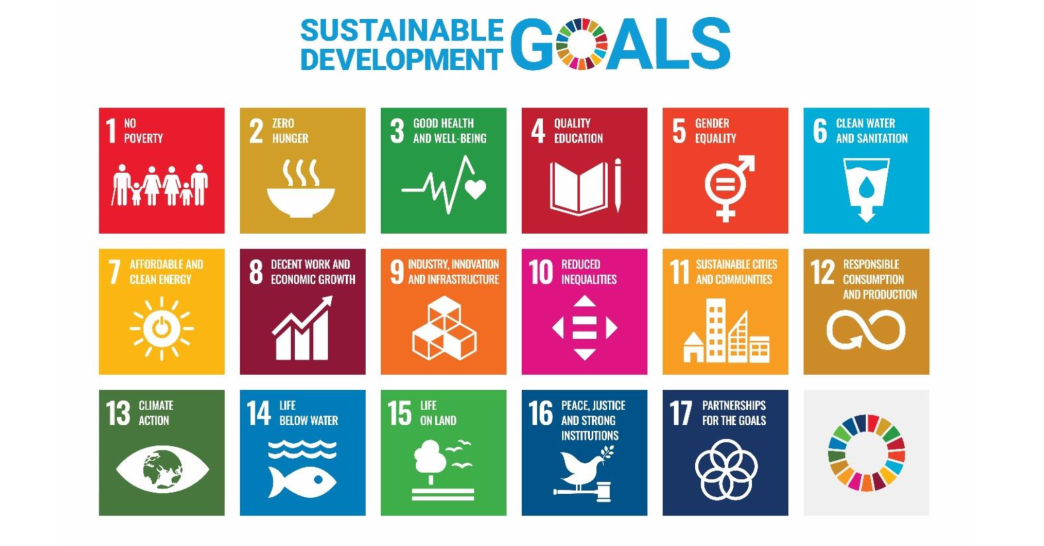
While typically presented individually, they cannot and should not be considered confined to their own ‘boxes.’ These goals are highly interrelated and can be grouped to create wider systems change.
Some investors naturally gravitate towards one, or a few, SDGs. At CSP, to simplify from 17 goals, we can group them into three primary themes.
Environmental goals
Environmental goals feature prominently in the SDGs. The Paris Agreement’s aim to target 1.5°C of global warming has made climate action globally visible. Yet environmental challenges extend beyond climate change to encompass various natural and biological ecosystems.
The five primarily environmental goals include:
- Goal 6 - Clean Water and Sanitation
- Goal 7 - Affordable and Clean Energy
- Goal 13 - Climate Action
- Goal 14 - Life below Water
- Goal 15 - Life on Land
Social goals
The SDGs emphasising social goals highlight key challenges facing humanity. Their intention is to improve quality of life, social cohesion, and promote social justice. Their focus can be in specific locations or across wider communities.
The six primarily social goals include:
- Goal 2 - Zero Hunger
- Goal 3 - Good Health and Well-Being
- Goal 4 - Quality Education
- Goal 5 - Gender Equality
- Goal 10 - Reduced Inequality
- Goal 11 - Sustainable Cities and Communities
Economic and governance goals
Economic goals focus on sustainable and inclusive economic growth, promoting prosperity without compromising environmental or social well-being. Linked to these are governance goals, which focus on improving strength and resilience of institutions and partnerships.
The six primarily economic and governance goals include:
- Goal 1 - No Poverty
- Goal 8 - Decent Work and Economic Growth
- Goal 9 - Industry, Innovation and Infrastructure
- Goal 12 - Responsible Consumption and production
- Goal 16 - Peace, Justice and Strong Institutions
- Goal 17 - Partnerships for the Goals
The strategic value of the SDGs
Though not explicitly designed for investors, the SDGs offer highly useful framework for sustainable
investing.
First, they convene and coordinate global effort by establishing common language for cooperation across
investors, companies, NGOs, and governments. They also provide banners beneath which communities
rally action.
Moreover, they can support novice sustainable investors begin impact measurement and management.
Each of the 17 goals has underlying targets and metrics to provide guidance on what outcomes and
objectives investments or portfolios can have.
Most importantly for families or organisations, they offer a simple framework to share, talk and align about
what you care about. With this you can take action, such as communicating with wealth managers about
your preferences, finding partners with shared interests, or identifying and assessing opportunities.
Determining the themes that matter to you
We all care about something. The issues that truly matter to you or your family are recognisable by your willingness to commit financial, social, and personal capital towards addressing them. Several approaches can help you to identify where to focus:
- Review your current activities: Examine ongoing efforts and underlying issues that already resonate, particularly related to existing family philanthropy or foundation.
- Assess the family business: Identify themes related to any existing family operating business, in terms of sector, operations, or impact of goods and services. These may create synergies, derisk sustainability challenges, or provide strategic alternatives.
- Consider your family history and legacy: Your family’s experiences may inspire focus areas through discussions with older generations or exploring your family’s story. Themes may also emerge during intergenerational wealth transfer planning centred on family values and priorities.
- Reflect on the SDGs: Review the 17 goals, or three groupings, to see which one(s) resonate most strongly with you, your family, or organisation. Facilitated exercises can also help to identify, prioritise, or combine thematic areas.
- Take an analytical approach: Rather than starting with personal connection, employ a calculated or diagnostic approach. Scientific frameworks like the nine Planetary Boundaries developed by the Stockholm Resilience Centre or calculations of how your capital can maximise positive benefit can help identify focus areas analytically.
By establishing clear ambitions, specific aims, and focused themes, you can transform sustainable investing from an abstract idea to a concrete strategy – enabling your wealth to contribute to the future you wish to create.
Voices of experience
Over ten years, CSP has trained over 240 participants in the Impact Investing for Next Generation programme. We have seen that when investors express their ambitions and aims linked to the SDGs, it can prove especially valuable, especially for cross-generational understanding. (This also can also enable families to communicate, connect, and commit as we’ll explore in Article 4.)
To bring this to life, we interviewed CSP alumni Carissa He about her experiences.
Carissa’s perspective:
At the intersection of impact and family legacy, Carissa has charted a distinctive path in business leadership. Originally establishing herself through a sustainable fashion venture, she has now returned to her family business with a clear mission: transforming traditional business models for positive impact.
She spearheads the company's sustainability strategy and climate transition planning, while simultaneously building an impact investment portfolio within the family office. Her journey reflects a thoughtful navigation between forging her own entrepreneurial path and leveraging her family's established resources - consistently seeking opportunities to drive meaningful change while balancing her vision with the values of the family.
“Our family cares about investing within the verticals of our core business for impact. However, we may speak different languages and terminologies as next generation and with our parents when it comes to impact. We need to communicate to realise it.
Once, I was having a conversation with my dad, when I had just got into the family office side of things. My dad was telling me how he invested in something in electrification of transportation and the EV battery space. However, he did not see it as impact investing, as he came from a financial lens and saw it as more like an innovation to bring financial returns to the business. In contrast, I saw this as impact investing or at least investing in our business for impact in green technology.
In addition, for family impact, we are also happy to donate to schools or contribute to the society that we grew up in.”
Reflection questions: Setting your destination and path
Building on your motivations from Article 1, consider these questions to identify your sustainable investing ambitions:
- What themes or issues really matter to you? Your family? Your organisation?
- In your ideal future world, what influence have your investments or portfolio had?
- What actions can steer your portfolio to help contribute to that future?
- What guidelines will help guide your investment process or decision-making?
- Over what timeframe or phases do you want to implement these changes?
Review the summaries of SDGs below and note which resonate most strongly. Reflect on your previous experiences to identify themes that have drawn your attention. Consider allocating 100 points across categories, and/or the underlying SDGs, to determine which ones are primary, secondary, or less relevant goals.
Environmental goals:
- Goal 6 – Clean Water and Sanitation: Ensure availability and sustainable management of water and sanitation for all.
- Goal 7 – Affordable and Clean energy: Ensure access to affordable, dependable, sustainable, and modern energy for all.
- Goal 13 – Climate Action: Take urgent actions to combat climate change and its impact.
- Goal 14 – Life below Water: Conserve and sustainably use the oceans, seas, and marine resources for sustainable development.
- Goal 15 – Life on Land: Protect, restore, and promote sustainable use of terrestrial ecosystems, sustainably manage forests, combat desertification, halt and reverse land degradation and biodiversity loss.
Social goals:
- Goal 2 – Zero Hunger: End hunger, achieve food security, improve nutrition, and promote sustainable agriculture.
- Goal 3 – Good Health and Well-Being: Ensure healthy lives and promote well-being for all at all ages.
- Goal 4 – Quality Education: Ensure inclusive and equitable quality education and promote lifelong learning opportunities for all.
- Goal 5 – Gender Equality: Achieve gender equality and empower all women and girls.
- Goal 10 – Reduced Inequality: Reduce inequalities among and within countries.
- Goal 11 – Sustainable Cities and Communities: Make cities and human settlements inclusive, safe, resilient, and sustainable.
Economic and governance goals:
- Goal 1 – No Poverty: End poverty in all its forms everywhere.
- Goal 8 – Decent Work and Economic Growth: Promote sustained, inclusive, and sustainable economic growth, full and productive employment, and decent work for all.
- Goal 9 – Industry, Innovation and Infrastructure: Build resilient infrastructure, promote inclusive and sustainable industrialisation and foster innovation.
- Goal 12 – Responsible Consumption and Production: Ensure sustainable production and consumption pattern.
- Goal 16 – Peace, Justice and Strong Institutions: Promote peaceful and inclusive societies for sustainable development, provide access to justice for all and build effective, accountable, and inclusive institutions at all levels.
- Goal 17– Partnerships for the Goals: Strengthen the means of implementation and revitalise the global partnership for sustainable development.
Barclays Private Bank disclaimer
This communication is general in nature and provided for information/educational purposes only. It does not take into account any specific investment objectives, the financial situation or particular needs of any particular person. It not intended for distribution, publication, or use in any jurisdiction where such distribution, publication, or use would be unlawful, nor is it aimed at any person or entity to whom it would be unlawful for them to access.
This communication has been prepared by Barclays Private Bank (Barclays) and references to Barclays includes any entity within the Barclays group of companies.
This communication:
(i) is not research nor a product of the Barclays Research department. Any views expressed in these materials may differ from those of the Barclays Research department. All opinions and estimates are given as of the date of the materials and are subject to change. Barclays is not obliged to inform recipients of these materials of any change to such opinions or estimates;
(ii) is not an offer, an invitation or a recommendation to enter into any product or service and does not constitute a solicitation to buy or sell securities, investment advice or a personal recommendation;
(iii) is confidential and no part may be reproduced, distributed or transmitted without the prior written permission of Barclays; and
(iv) has not been reviewed or approved by any regulatory authority.
Any past or simulated past performance including back-testing, modelling or scenario analysis, or future projections contained in this communication is no indication as to future performance. No representation is made as to the accuracy of the assumptions made in this communication, or completeness of, any modelling, scenario analysis or back-testing. The value of any investment may also fluctuate as a result of market changes.
Where information in this communication has been obtained from third party sources, we believe those sources to be reliable but we do not guarantee the information’s accuracy and you should note that it may be incomplete or condensed.
Neither Barclays nor any of its directors, officers, employees, representatives or agents, accepts any liability whatsoever for any direct, indirect or consequential losses (in contract, tort or otherwise) arising from the use of this communication or its contents or reliance on the information contained herein, except to the extent this would be prohibited by law or regulation.
Barclays offers private and overseas banking, credit and investment solutions to its clients through Barclays Bank PLC and its subsidiary companies. Barclays Bank PLC is authorised by the Prudential Regulation Authority and regulated by the Financial Conduct Authority and the Prudential Regulation Authority (Financial Services Register No. 122702) and is a member of the London Stock Exchange and Aquis. Registered in England. Registered No. 1026167. Registered Office: 1 Churchill Place, London E14 5HP.
Barclays Bank PLC, Jersey Branch has its principal business address in Jersey at 13 Library Place, St Helier, Jersey and is regulated by the Jersey Financial Services Commission. Barclays Bank PLC, Isle of Man Branch has its principal business address in the Isle of Man at Barclays House, Victoria Street, Douglas, Isle of Man and is licensed by the Isle of Man Financial Services Authority. Barclays Bank PLC, Guernsey Branch has its principal place of business at St Julian’s Court, St Julian’s Avenue, St Peter Port, Guernsey and is licensed by the Guernsey Financial Services Commission under the Banking Supervision (Bailiwick of Guernsey) Law 1994, as amended, and the Protection of Investors (Bailiwick of Guernsey) Law 1987, as amended.
Barclays Bank Ireland PLC, trading as Barclays and as Barclays Private Bank, is regulated by the Central Bank of Ireland. Registered in Ireland. Registered Office: One Molesworth Street, Dublin 2, Ireland, DO2 RF29. Registered Number: 396330. VAT Number: IE4524196D. Calls are recorded in line with our legal and regulatory obligations, and for quality and monitoring purposes.
Barclays Bank (Suisse) SA is a bank registered in Switzerland and regulated and supervised by the Swiss Financial Market Supervisory Authority FINMA. Registered No. CHE-106.002.386. Registered Office: Chemin de Grange-Canal 18-20, 1224 Chêne-Bougeries, Switzerland. Registered branch: Beethovenstrasse 19, 8002 Zurich, Switzerland. Registered VAT No. CHE-106.002.386. Barclays Bank (Suisse) SA is a subsidiary of Barclays Bank PLC.
In the Principality of Monaco, Barclays Bank PLC operates through a branch which is duly authorised and falls under the dual supervision of the Monegasque regulator ‘Commission de Contrôle des Activités Financières’ (with regards to investment services) and the French regulator ‘Autorité de Contrôle Prudentiel et de Résolution’ (in respect of banking and credit services, and prudential supervision). The registered office of Barclays Bank PLC Monaco branch is located at 31 avenue de La Costa, MC 98000 Monaco – Tel. + 377 93 15 35 35. Barclays Bank PLC Monaco branch is also registered with the Monaco Trade and Industry Registry under No. 68 S 01191. VAT No. FR 40 00002674 9.
Barclays Bank PLC (DIFC Branch) (Registered No. 0060) is regulated by the Dubai Financial Services Authority. Barclays Bank PLC (DIFC Branch) may only undertake the financial services activities that fall within the scope of its existing DFSA licence. Principal place of business: Private Bank, Dubai International Financial Centre, The Gate Village Building No. 10, Level 6, PO Box 506674, Dubai, UAE. This information has been distributed by Barclays Bank PLC (DIFC Branch). Certain products and services are only available to Professional Clients as defined by the DFSA.
Barclays Bank Plc (Incorporated in England and Wales) (Reg. No: 2018/599243/10) is an authorised financial services provider under the Financial Advisory and Intermediary Services Act (FSP 50570) in South Africa and a licensed representative office of a foreign bank under the Banks Act, 1990. Barclays Bank PLC, has its principal place of business in South Africa, at The Business Exchange, 140 West St, 4th Floor, Sandton 2057.
Barclays Bank PLC Singapore Branch is a licenced bank in Singapore and is regulated by the Monetary Authority of Singapore. Registered in Singapore. Registered No. S73FC2302A. Registered Office: 10 Marina Boulevard, #25-01, Marina Bay Financial Centre Tower 2, Singapore 018983.
Barclays Bank PLC, India branch (FCRN F01106) is regulated for its banking business and as authorised dealer by Reserve Bank of India and is registered with the Securities and Exchange Board of India as merchant banker and banker to an issue. Its principal place of business in India is at Level 32 and 33 (3301 A), Altimus, Worli Estate, Pandurang Budhkar Marg, Worli, Mumbai 400018, India. Transactions, products and services as offered from time to time are subject to the applicable laws and regulations of India.
You might also be interested in
Insights
Starting Your Family's Sustainable Investing Journey Part 4: How Do You Bring Others On The Journey?
The 3Cs framework: communication, connection, and commitment aims to help families find common ground and move forward together.

Insights
Starting Your Family's Sustainable Investing Journey Part 3: What Obstacles Will You Encounter?
Internal mindsets, family dynamics, and social norms are the real obstacles to sustainable investing. A guide on how to spot them.

Insights
Starting Your Family's Sustainable Investing Journey Part 1: Why Start The Journey?
Discover the four key motivations that drive families toward sustainable investing and what they mean for your portfolio.
