

Blink Impact is one of three lead case studies featured in CSP's upcoming program, How Leading Family Offices Grow Future-Fit with Impact, taking place 22–24 June in London. We sat down with Ana Pimenta to explore how the family office developed its theory of change, operationalized impact across the organization, and cultivated a culture where purpose is more than a statement on a wall.
Can you briefly describe Blink's philosophy of impact and how you approached developing your theory of change?
At Blink, impact is the starting point for decision-making. As an impact-first organization, we see investment as a tool to challenge existing systems and contribute to a more regenerative and inclusive future.
Our mission is to "connect people and nature for lasting change," and we pursue this through two pillars: driving regenerative innovation and openly creating and inspiring. The first keeps us focused on projects that aim to regenerate, whether in agriculture, tourism, energy, communities, or beyond. The second reminds us how important it is to create and share knowledge in order to achieve long-term systemic positive change.
Our theory of change emerged directly from the family's vision, mission and values. We translated that into a clear framework connecting the change we want to see in the world with the initiatives and projects we support. It guides where we focus, how we collaborate with entrepreneurs and partners, and how we measure whether we're truly contributing to meaningful outcomes.
What I think is important for others to know is that this was an iterative process. We didn't develop just one theory of change, but several over time. In fact, we were already operationalizing aspects of our impact approach before arriving at the current version. I believe this is a natural process: Ideas need to be applied and tested before everyone can clearly see how they connect. We continue to see our theory of change as a living framework that evolves as we learn.
How did you translate that framework into operations?
One of the most important first steps was embedding impact into decision-making rather than treating it as a separate activity. From the beginning, we involved multiple stakeholders — from the family and the board to our initiatives on the ground — to ensure impact wasn't only defined at a strategic level but also connected to the realities of the work being done in practice.
Another important step was fostering close collaboration between the different initiatives and the impact team. Working together allows us to better assess opportunities, support projects and portfolio companies, and continuously improve how we measure and manage impact.
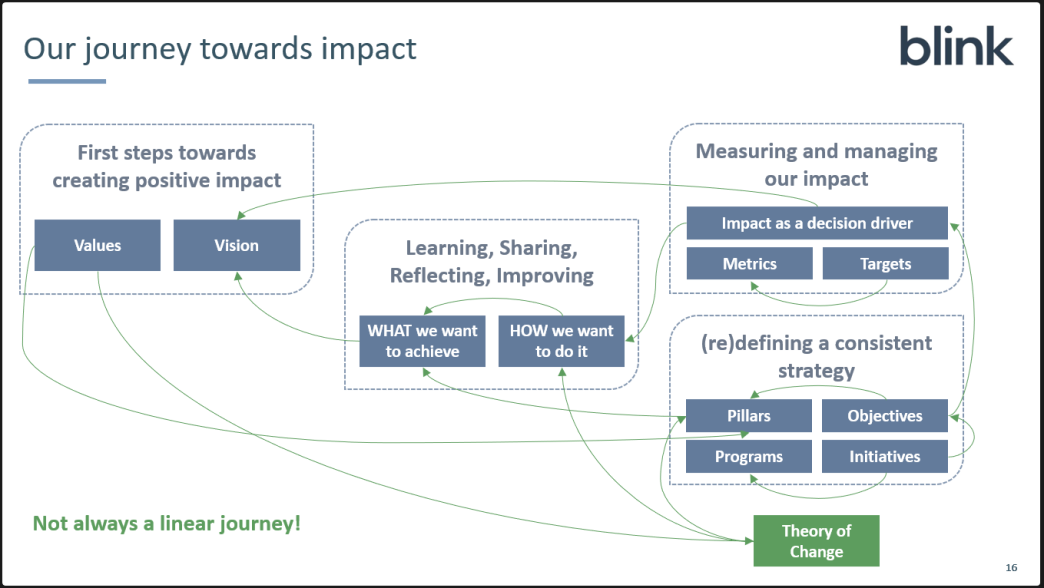
I once presented a slide (fig. below) at a conference to illustrate our journey towards impact as a non-linear one. It’s a process that moves forward and backward, constantly challenging our assumptions and helping us improve.
What was your approach to building an impact culture at Blink?
We made a deliberate choice to embed impact across the entire organization rather than having it sit within a single function. At the same time, a key element of building our impact culture has been having people fully dedicated to driving impact both internally and externally. Their role isn’t just to support internal initiatives; it’s to connect strategy, measurement, and learning across everything we do and the projects we support.
We also actively collaborate with universities, research centres, and nonprofits in the impact ecosystem, and regularly share what we're learning through articles, conferences, and trainings.These partnerships not only help us continuously improve our own approach, but also contribute to the development of the field and are an important part of our impact culture.
Based on Blink's impact journey, what advice would you give other family offices looking to integrate impact into their investment and governance?
Building a meaningful impact strategy takes time, and it is rarely linear. It requires experimentation, learning, and continuous refinement. As a first-generation family office, we built much of this from scratch, and being open about that journey, including with peers, helped us improve and move forward faster.
Collaboration is essential. No organization can drive systemic change alone. Engaging with others in the ecosystem, asking for help, and sharing knowledge can significantly accelerate progress. It's also critical to bring the right people on board: people who understand the family's vision and are committed to the long-term goals, but who are also curious enough to learn and adapt as the field evolves.
There is no single model for impact, and what matters most is having clear purpose and goals supported by the right teams and structures. Family offices are uniquely positioned here. They can be flexible, innovative, and willing to take risks. They can experiment with new funding approaches, innovative structures, or different ways of being involved. The focus should be on what a project needs in order to maximize impact, rather than only on what we as investors want or expect.
Finally, family offices have the opportunity to do far more than provide financial capital. At Blink, we tend to be quite active with the organizations we support — contributing time, networks, and strategic guidance to help teams strengthen their purpose and create long-term value. I believe this is where family offices can play a particularly meaningful role.
In your opinion, how can this program help family offices grow future-fit with impact?
Programs like this can play an important role in helping family offices move from intention to implementation. Translating impact ambition into a clear strategy, governance structures, and operational processes can be complex — and often, a lonely endeavour. Being in a room with practitioners navigating the same questions, learning from different experiences and approaches, and reflecting on what works (and what doesn’t) in practice enables participants to gain insights not only from frameworks and tools, but from real journeys, experimentation, and lessons learned.
From our perspective at Blink, being part of conversations like this is particularly valuable because it allows us to exchange perspectives with other family offices and contribute to the collective learning of the field. Ultimately, becoming "future-fit with impact" means building organizations that are able to innovate, collaborate, and continuously improve how they contribute to solving the most complex challenges of our time. And together, we can go much faster.
Ana Pimenta is Chief Impact Strategist at Blink Impact and a featured speaker at CSP's Family Office program, How Leading Family Offices Grow Future-Fit with Impact, taking place 22–24 June in London. The program is designed exclusively for Principals and Single Family Office leadership.
You might also be interested in
Applied Research
Insights from Journeys of Eight Asian Families
This guide features eight diverse, multi-generational families in Asia who are intentionally deploying capital and leveraging business for good.

Insights
Which of the 10 ingredients for impact investing is your family office missing?
A framework and real family office stories to help you identify your gaps in impact investing and how to move forward.

Program for Wealth Holders
How Leading Family Offices Grow Future-Fit with Impact - Singapore
Singapore | November 11 - 13, 2026 | Following a sold-out 2026 edition in London.
